
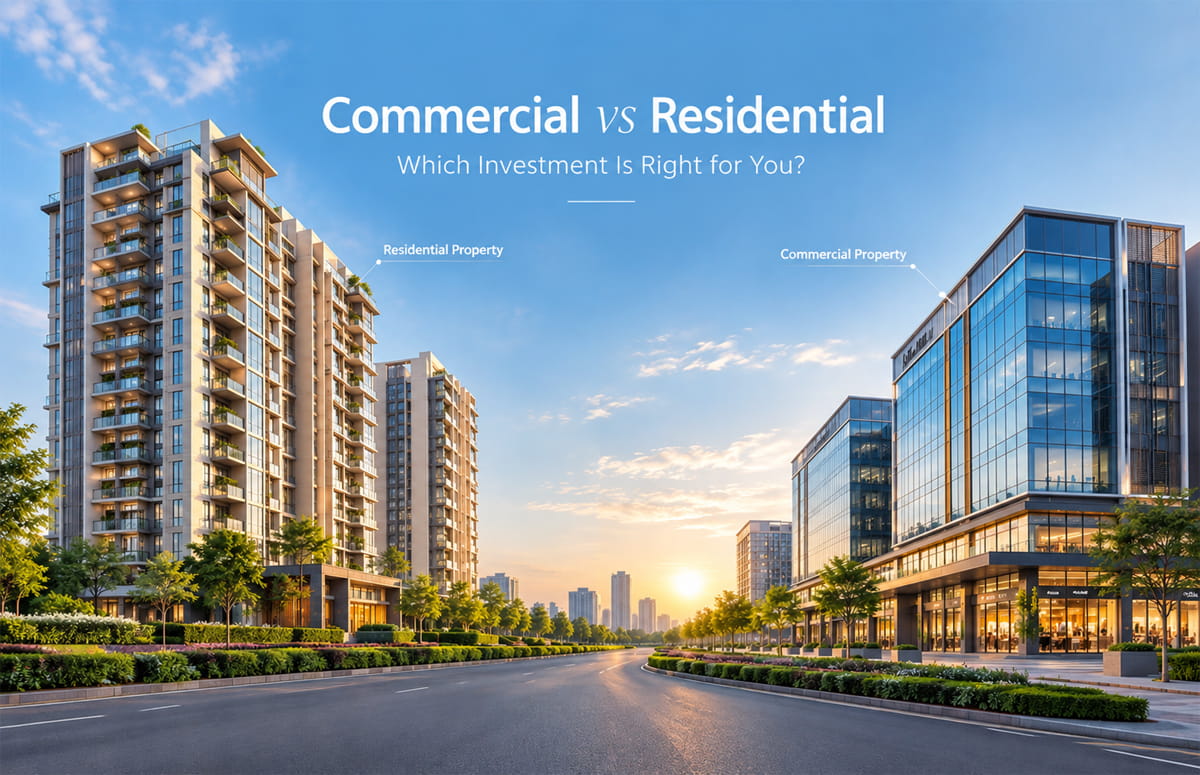
When it comes to property investment, one of the most important decisions is choosing between commercial and residential real estate. Both options can offer opportunities for capital growth and income, but they have different characteristics, risks and investment requirements.
Understanding the key differences between commercial and residential property can help investors choose an option that better matches their budget, investment goals and risk appetite.
Commercial vs Residential Investment
Residential property generally includes apartments, villas, independent houses and other homes purchased for personal use or rental purposes. Commercial property includes office spaces, retail shops, commercial units, studio spaces and other properties intended primarily for business use.
While both categories are part of the real estate market, their demand drivers, rental structures, investment sizes and exit strategies can be quite different.
1. Investment Cost
Residential properties are available across a wide range of budgets, making them accessible to a larger number of buyers. Apartments can often be purchased with home loans and structured payment plans, depending on the project and buyer's eligibility.
Commercial properties can require a higher initial investment, particularly for prime retail and office locations. However, smaller commercial units and studio options can also provide entry-level opportunities depending on the project and location.
2. Rental Income
Rental income is one of the major reasons investors consider real estate. Residential properties generally have a large tenant base consisting of families, students and working professionals.
Commercial properties can potentially offer higher rental yields in suitable locations, particularly when there is strong demand from businesses and retailers. However, rental income depends heavily on location, tenant demand, property type and market conditions.
3. Tenant Demand
Residential rental demand is generally supported by the need for housing. Areas with employment opportunities, educational institutions, healthcare facilities, transport connectivity and social infrastructure can attract a steady pool of tenants.
Commercial tenant demand depends more on business activity, footfall, visibility, accessibility and the surrounding commercial ecosystem. A well-located commercial property may attract businesses looking for office, retail or service-oriented space.
4. Appreciation Potential
Both residential and commercial properties can appreciate over time, but appreciation depends on several factors including location, infrastructure development, supply and demand, developer reputation and overall economic conditions.
Residential property may benefit from population growth and increasing demand for homes, while commercial property can benefit from business expansion, increasing footfall and the development of new residential communities around the project.
5. Risk and Vacancy
Residential properties generally have a broad tenant market, which can make finding a new tenant comparatively easier in locations with strong housing demand. However, vacancy periods and maintenance costs still need to be considered.
Commercial properties may experience longer vacancy periods if the location or property type has limited tenant demand. Investors should therefore carefully evaluate the commercial ecosystem, expected footfall, surrounding developments and potential tenant profile before investing.
6. Maintenance and Management
Residential properties usually involve regular maintenance, society charges, repairs and other costs associated with keeping the property suitable for tenants or personal use.
Commercial properties can have additional maintenance and operational considerations depending on the type of property, building facilities and usage. Investors should understand all applicable maintenance and management costs before calculating expected returns.
7. Financing Options
Financing options can differ significantly between residential and commercial properties. Home loans are commonly used for residential purchases, subject to the buyer's eligibility and lender requirements.
Commercial property financing may have different eligibility criteria, interest rates, loan structures and documentation requirements. Investors should compare financing costs carefully before finalising an investment.
Which Is Better: Commercial or Residential Property?
There is no single answer that is suitable for every investor. The right choice depends on the investor's budget, investment horizon, income expectations, risk tolerance and purpose of investment.
Residential property may be more suitable for buyers looking for a home, long-term residential demand and comparatively broad tenant requirements. Commercial property may be attractive to investors seeking rental income and exposure to business-oriented real estate.
What Should You Check Before Investing?
Before investing in either residential or commercial property, buyers should conduct proper due diligence and evaluate the property beyond its advertised price.
- Developer reputation and track record
- UP RERA registration and project details
- Location and connectivity
- Current and future infrastructure development
- Property pricing and total acquisition cost
- Rental demand and expected rental income
- Maintenance and other recurring costs
- Resale and exit potential
Commercial vs Residential Investment in 2026
In 2026, both residential and commercial real estate continue to offer opportunities across Delhi NCR. Residential markets are supported by housing demand, while commercial markets can benefit from the expansion of businesses, retail activity and new residential catchments.
Investors should avoid making a decision based solely on expected returns. The specific location, project quality, developer credentials, demand, pricing and investment horizon are equally important when evaluating a property.
Final Thoughts
Commercial and residential properties can both play an important role in a diversified real estate investment strategy. Residential property can provide access to a broad end-user and rental market, while commercial property may offer attractive income opportunities in well-established or developing business locations.
The best investment is ultimately the one that matches your financial objectives and risk profile. Before investing, compare multiple properties, verify project details and approvals, understand the complete cost and evaluate the property's long-term potential.
Looking for Property Investment Opportunities?
Get assistance in finding suitable residential and commercial properties across Noida, Greater Noida West and Delhi NCR.
Enquire Now →